PDF Creative Specs + Best Practices Guide (Beta)
Your marketing mail is a tangible extension of your brand that consumers welcome into their homes. To elevate your programmatic direct mail marketing programs, we’re enhancing PebblePost’s creative workflows with print-ready PDFs. The result: dynamic personalization, streamlined workflows, and more flexibility for your branding.
Important note: for details on how to include Dynamic Elements in your PDFs, please reference this article.
Getting Started with PDFs
Please see below for template specs and presets:
- PDF Specs
- PDF Templates for InDesign
- When using InDesign, you must use the PebblePost PDF Preset
Best Practices for High-Quality PDFs
PebblePost now supports PDF assets for all creative formats: postcard, 4-panel, and 6-panel.
- All image editing should be done in Photoshop, including adding gradients, transparency, etc. before you upload to InDesign.
- Embed your text
- Link all images before exporting to a PDF
- Color model should always be CMYK
- Remove any crop marks
- Max file size is 12MB
- All elements within the template (for ex: images, text, etc.) should be at a 300 DPI resolution; keep all other template settings the same when exporting.
- All PDFs should be exported as flattened
- Go to File → Adobe PDF Presets → Define…
- Click New (or duplicate PDF/X-4 if that’s their normal preset).
- Under Advanced → Transparency Flattener Preset, choose High Resolution.
- Export as PDF/X-1a:2001 — this forces transparency flattening and eliminates the Multiply issue.
- Note: This converts live transparency to raster/vector composites, which are much safer for Indigo and offset workflows.
- Create one PDF; each panel (for ex: front panel or mailing panel) should be its own page
- All PDF pages should be exported as the same size and orientation. For example, please export all 4 x 6 postcard pages as landscape
- The front panel always has to be the first page of the PDF. For postcards, that means mailing panel is page 2. For brochures, that means the spread with front panel and mailing panel will be your first page.
- All PDF uploads must be inclusive of the bleed specs
How to Upload PDFs to the PebblePost Platform
- Create print-ready PDFs using the creative templates and following the PDF best practices.
- Upload your PDF to the Creative Manager Tool in the platform
- The Creative Elements panel appears automatically when the platform detects supported dynamic placeholders in your PDF (offer codes, expiration dates, first name, store address, and barcode). You will only see formatting fields that apply to the placeholders present in your PDF. See the "How to Format Dynamic Elements" section for more details.
- Formatting fields are editable while the creative is in draft (before submitting for proofing). After creatives are sent for proofing, formatting fields are locked. Any changes to formatting require a new upload.
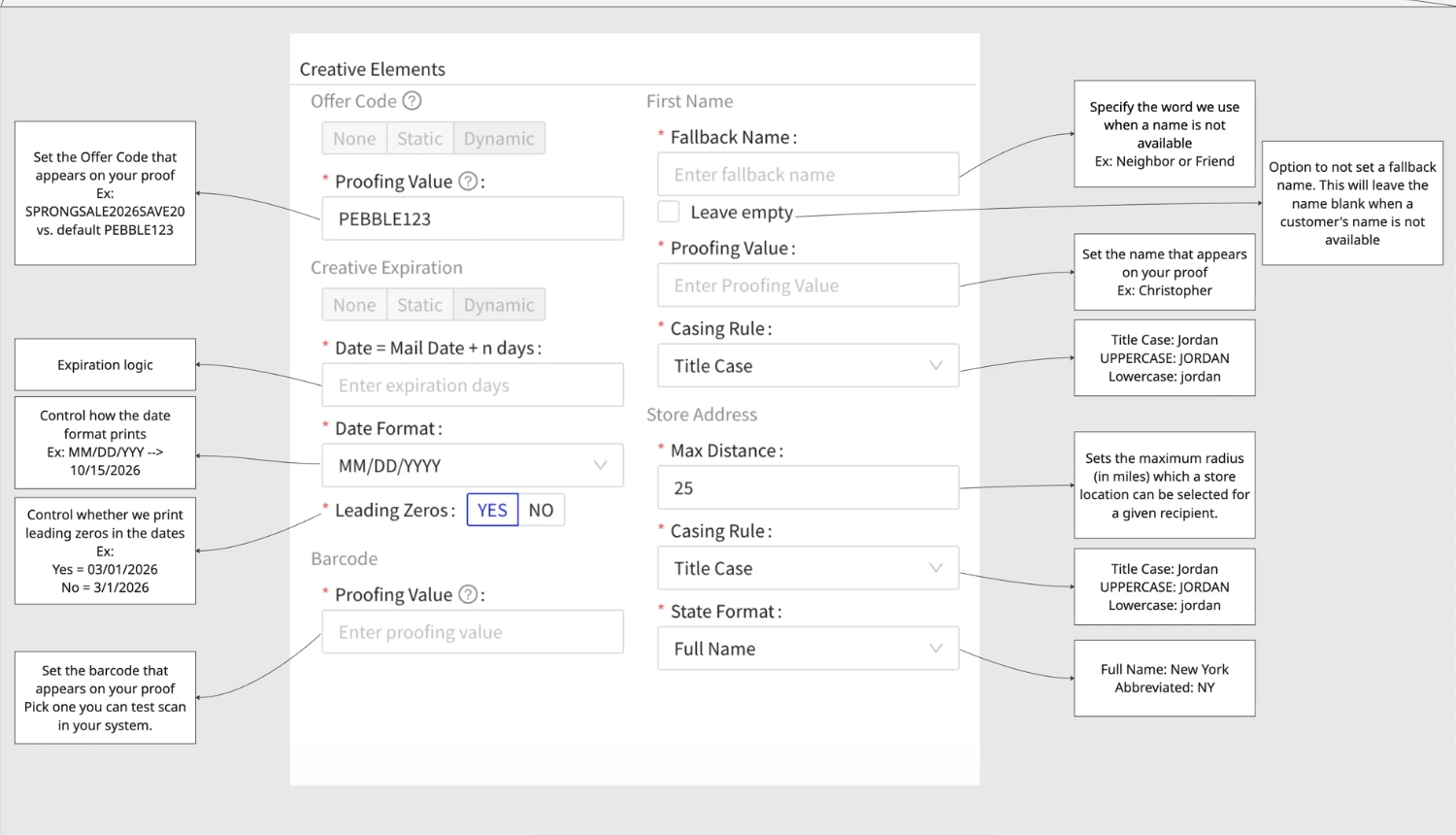
- Submit your creative for review. PebblePost reviews your PDF creative and generates a digital proof within 24-48 hours.
- You will receive an automated email when digital proofs are ready for review in the PebblePost Platform. You can approve the proof directly on the platform to start deploying the following day.
How to Format Dynamic Elements
Offer Code
Field name: Proofing Value (under Offer Code)
- What it does:
- Lets you specify the exact offer code string you want to see on the digital and physical proofs. (ex, SPRINGSALE2026SAVE20 vs the generic PEBBLE123)
- When to use it:
- When you use long or formatted codes and need to verify they fit visually.
- When you want to see a realistic example of how the codes will appear on the card.
- What to expect:
- The proofing value is only used for proof generation. Live mailings still pull real codes from your dynamic element bank.
Expiration Date
Field name: Date = Mail Date + N days
- What is does:
- Adds the specified number of days to the mail date and sets that as the expiration date for that day.
- What to expect:
- Recipients all get the same time to act
Field Name: Date Format
- What it does:
- Controls how the date itself prints when you use a dynamic expiration date.
- Example formats:
- MM/DD/YYYY → 3/1/2026
- MM/DD/YY → 3/1/26
- MM/DD → 3/1
- MONTH DD, YYYY → March 1, 2026
- MON DD → Mar 1
- What to expect:
- The dropdown shows examples using today’s date, so you can see the exact pattern.
Field name: Leading Zeros
- What it does: Controls whether we print leading zeros in the dates.
- Yes: 03/01/2026, March 01, 2026
- No: 3/1/2026, March 1, 2026
- When to use it:
- Use “No” if your brand style guide prefers dates without leading zeros.
- Note:
- This formatting layer sits on top of the expiration logic you configure (Mail Date + N days). Changing the format will not change the underlying expiration window.
First Name
Field name: Fallback Name
- What it does:
- Specifies the word we use when a name is missing (ex, for customer who we can’t resolve a first name)
- Examples
- Sailor
- Neighbor
- Friend
- Option to leave it blank (check the box)
- What to expect:
- When a first name is available, we use the dynamic name.
- When it is not, we use the fallback name instead
- Note:
- This means you can include punctuation around the name when designing the creative.
Field Name: Proofing Value (under First Name)
- What it does:
- Sets the name that appears on your proof (ex, Christopher or Stephanie) so you can confirm spacing and casing
- What to expect:
- Only affects proofs. Live mail uses real names + fallback rules.
Field Name: Casing rule (Name casing)
- Options:
- Title Case: Jordan
- UPPERCASE: JORDAN
- Lowercase: jordan
- What to expect:
- All dynamic first names for this creative will follow the rule you select
Store Address
Field name: Max Distance
- What is does:
- Sets the maximum radius (in miles) which a store location can be selected for a given recipient.
- What to expect:
- If a recipient is more than the max distance from any store, they will receive the alternative panel on their mailer.
Field name: Casing Rule (Store Address casing)
- What is does: Controls if addresses appear in:
- Title Case: 123 Main St
- UPPERCASE: 123 MAIN ST
- Lowercase: 123 main st
- What to expect:
- Applied consistently to all dynamic store addresses for this creative.
Field name: State Format
- What it does: Controls how state is rendered:
- Abbreviated: NY
- Full name: New York
- What to expect:
- Applied consistently to all dynamic store addresses for this creative.
Barcode
Field name: Proofing Value (barcode)
- What it does:
- Sets the barcode that appears on your proof. Pick one that can be tested in your system.
- What to expect:
- The proofing value is only used for proof generation. Live mailings still pull real codes from your dynamic element bank.
Error Messages When Uploading PDFs
If your PDF does not follow the provided specs and best practices, you will see an error message at the top of the screen. See below for common error messages and how to resolve them. Please update your PDF and re-upload it to the platform. Once any issues have been resolved, PebblePost reviews your PDF creative and generates a digital proof within 24-48 hours.
If you are receiving an error message not listed below, please reach out to your Operations Manager at PebblePost for support.
Example Error Message |
What it could mean |
How to resolve |
Where to get help |
|
“403 Forbidden” “Error handling file change” |
Contents of the PDF are being blocked by security filters | Reach out to your Operations Manager | |
| “Error: The PDF document contains unsupported dynamic element: Zip.” |
1. Used an incorrect format for the dynamic element placeholder or 2. Didn’t embed the text of the placeholder properly |
Check the format of the DE. Validation is case sensitive. If format looks good, check that all DEs are embedded text. |
Reference the PDF Creative Specs & Best Practices Guide for format. Be sure the DE is embedded text. |
| “The PDF page size is 18.13 x 9.25 in. This page size is not supported. Please refer to Creative Specs & Guides above.” |
1. One or more pages in the PDF are the wrong size. 2. One or more pages has the wrong orientation. |
The dimensions stated in the error message are what our platform is reading. Reference the guide for what the dimensions should be. All pages must be in landscape even if the artwork orientation is portrait. |
Reference the PDF Templates. |
| Times out - PDF never loads |
File is too large and took too long to load so the platform timed out. You may even see a successful status but the PDF won’t load. |
Decrease the size of the file by removing unnecessary transparent and background elements. File must be 12MB or smaller |
|
| “The store address PDF must contain at least one store address dynamic element.” | There is a third page in the PDF but no store address placeholders are recognized. | Make sure placeholders are present, in the right format, wrapped in brackets, and embed the text | Reference the PDF Creative Specs & Best Practices Guide. |
| “PDF creative needs to contain 3 pages if it has dynamic store address.” | We recognize store address placeholders but there is not a third page in the PDF (alt panel). | Add a third page to be used as the alternative for the store address panel. | Reference the PDF Creative Specs & Best Practices Guide. |
| “PDF creative file needs to contain 2 pages.” | File contains less than or more than 2 pages. (not applicable for store addresses) | All brochures are now submitted as 2-page spreads instead of individual panels. | Reference the PDF Templates. |
| “Embedded images with a resolution below 300 DPI are not allowed” | At least one of the embedded images in the PDF is below 300 DPI. | Use high-res images. | Reference the PDF Creative Specs & Best Practices Guide. |